
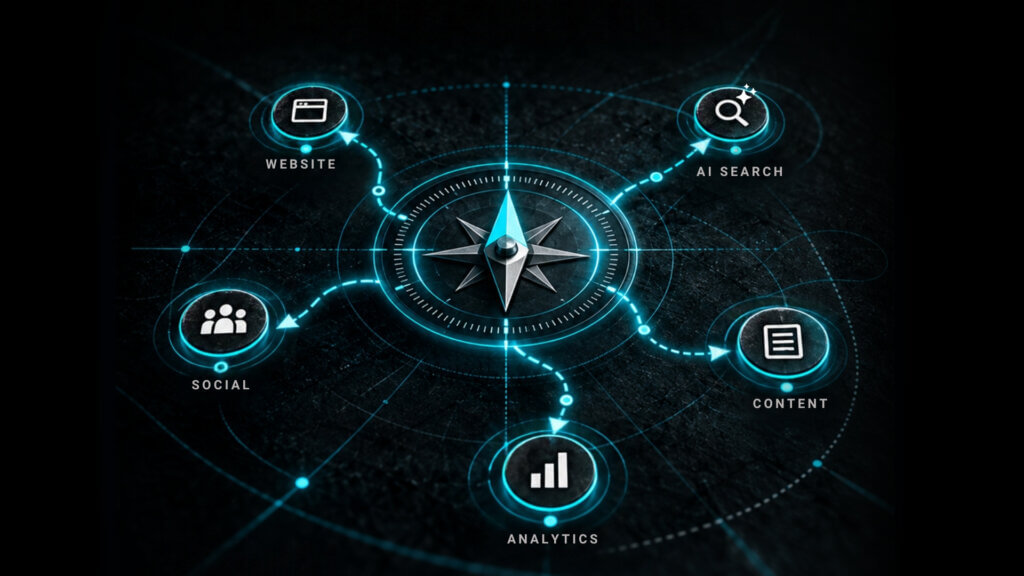
If your company is doing $50 million to $500 million in revenue, there is a good chance your 2027 marketing plan is being built the same way it has been for years.
The problem is that buyers do not experience your company in those separate buckets.
They might discover you on LinkedIn, see you again in Google, ask ChatGPT who the leading companies in your category are, visit your website, disappear for three weeks, talk to someone in their network, come back directly, read a case study and eventually contact sales.
Then somebody looks at the analytics and says the lead came from “direct.”
That is the reality companies are planning against now.
And I think it changes how marketing budgets should be built for 2027.
Stop starting with channels
One of the biggest mistakes companies make is deciding how much they want to spend on marketing channels before defining the business problem they are trying to solve.
- Are the right buyers finding us?
- Do they understand what makes us different?
- Are we making the shortlist?
- Does our website make us look like a $200 million company or a $20 million company?
- Are we creating enough trust?
- Are we giving buyers enough proof?
- Are we reaching people early enough in the buying process?
- Are we generating demand or simply waiting for demand to appear?
Those questions should determine the marketing plan.
The channels come after.
Your website is still one of your biggest sales tools


A lot of middle-market companies have grown faster than their marketing.
The business may be doing $100 million or $300 million in revenue while the website still feels like it was built for the company they were seven years ago.
That creates a problem.
A buyer may know nothing about your internal growth, operational strength, client base or capabilities.
They see what you show them.
Your website needs to quickly communicate:
- Who you help.
- What problems you solve.
- Why you are different.
- Why someone should trust you.
- What proof you have.
- What they should do next.
A website should not simply look good.
It should help someone make a buying decision.
Search has changed, but the objective has not

Companies still need to be found.
What has changed is where discovery happens.
Traditional search still matters.
But buyers are increasingly using AI platforms to research companies, compare options and understand categories before they ever speak with sales.
That means your content strategy cannot be based only on ranking for broad keywords.
You need to answer the questions buyers are actually asking.
- Specific questions.
- High-intent questions.
- Industry questions.
- Comparison questions.
- Questions about cost, risk, implementation, timing and results.
This is where a lot of companies get content wrong.
They produce generic content because generic content is easy to approve.
But generic content rarely gives a buyer a reason to remember you.
More content is not the answer
AI has made content production dramatically easier.
That does not automatically make marketing better.
In fact, it may create the opposite problem.
We are heading into a period where companies can create more content than ever before.
More articles.
More posts.
More emails.
More landing pages.
More videos.
More everything.
The question is whether any of it is worth consuming.
I would rather see a company publish one strong piece of content that answers an important buyer question than twenty articles nobody needed.
The objective is not volume.
The objective is relevance.
AI is a tool, not a marketing strategy
AI is going to change how marketing gets done.
It already has.
It can help us research faster.
Analyze faster.
Write faster.
Build faster.
Test faster.
Personalize faster.
But speed is not the same thing as judgment.
- AI does not automatically understand the history of your company.
- It does not know why your brand looks the way it does.
- It does not know why a campaign failed three years ago.
- It does not know which customers looked great on paper but became terrible clients.
- It does not understand your internal politics.
- It does not know what your salespeople have heard from customers for the past ten years.
- It does not know why a seemingly small brand decision matters to your organization.
Unless you give it that context, it does not have it.
That is why I think a few years from now we will talk about AI very differently.
We will not constantly say, “we used AI to do this.”
We will talk about it the way we talk about Salesforce, Google Docs, Adobe or any other business platform.
It will simply be one of the tools used to get the work done.
The competitive advantage will not be owning an AI tool.
Everyone will have access to the tools.
The advantage will come from what people do with them.
Strategy and creativity still matter because people still make decisions

They still need to understand something before they can believe it.
They still need to trust something before they can buy it.
They are still influenced by risk, credibility, emotion, timing, reputation, familiarity and social proof.
That is not changing.
Marketing still needs people who understand how humans are motivated.
How they are persuaded.
How they learn.
How they build confidence.
How they evaluate risk.
How they justify decisions internally.
Technology can accelerate the process.
It cannot replace the need to understand the person on the other side of the screen.
One of the biggest marketing problems is internal
This is something more companies need to talk about.
Organizations hire marketing experts and then limit nearly everything those experts are allowed to do.
- They want stronger visibility, but only want to publish once a month.
- They want better search performance, but do not want to add meaningful content to the website.
- They want thought leadership, but every strong opinion gets diluted through approvals.
- They want more leads, but do not want to change the website.
- They want better social performance, but only want to post company announcements.
- They want marketing to move quickly, but every idea requires six approvals.
At some point, that stops being a marketing problem.
It becomes an operating problem.
There should absolutely be guardrails.
Brand standards matter.
Compliance matters.
Legal matters.
Reputation matters.
There is a difference between guardrails and handcuffs.
If you hire people because they understand marketing, you have to give them enough room to do the job.
Otherwise, you are not hiring them for expertise.
You are hiring them to execute decisions you have already made.
Those are two very different relationships.
Marketing needs permission to test
Another issue I see frequently is the expectation that every idea needs to be proven before it is tried.
That sounds responsible.
It is also unrealistic.
Marketing involves hypotheses.
You try something.
You measure it.
You learn.
You improve it.
That does not mean throwing money at bad ideas.
It means understanding that experimentation is part of the work.
You cannot ask for innovation while demanding certainty.
If every idea has to be guaranteed to work before it gets approved, the safest ideas will always win.
And the safest ideas are usually the ones everyone else is already doing.
Stop treating brand and lead generation as opposites
This distinction is becoming less useful.
They may read something you wrote.
See a LinkedIn post.
Search your name.
Visit your website.
Ask an AI platform about you.
Get an email.
Hear your name from someone else.
Then eventually submit a form.
Which one generated the lead?
Probably all of them.
This is why companies need to be careful with last-click thinking.
The thing that happened immediately before the conversion is not necessarily the thing that created the demand.
Your 2027 marketing budget should follow buyer behavior
If I were planning marketing for a $50 million to $500 million company right now, I would not start by deciding what percentage goes to SEO, paid media, social, content or AI.
I would start with the buyer.
- How do they discover companies like ours?
- What questions are they asking?
- What are they afraid of?
- What proof do they need?
- What makes them trust one company over another?
- Why do we make the shortlist?
- Why do we lose?
- Where are we invisible?
- Where does the buying process slow down?
- What is sales hearing that marketing is not addressing?
- What does our website fail to communicate?
Then I would build the marketing plan around those answers.
The tactics should support the strategy.
Not the other way around.
This is how we think about marketing at CMDS
We do not start by trying to sell a company a channel.
We start by understanding the business.
- Where it is trying to go.
- What is getting in the way.
- How buyers actually make decisions.
- What the data is telling us.
- What sales is seeing.
- What competitors are doing.
- Where the company is underrepresented.
Then we determine what needs to happen.
Sometimes that means the website.
Sometimes it means search.
Sometimes content.
Sometimes paid media.
Sometimes outbound.
Sometimes AI visibility.
Usually it is a combination.
But the recommendation should come from the business problem, not from the service an agency happens to want to sell.
And once that strategy is agreed upon, the company has to give the people doing the work enough room to execute it.
That part matters more than most companies realize.
The question I would ask before approving a 2027 marketing budget
Because if the answer is no, adding another 10% to the budget probably will not fix the problem.
You may just end up spending more money on a system that was built for a buyer journey that no longer exists.